An uncontested divorce is a Georgia divorce in which both spouses agree on every term before the case is filed, and both are willing to sign the documents. The agreement must cover every part of the divorce, including:
If any of these is still in dispute, the case is not yet uncontested, but negotiation or mediation can often get you there. Even when spouses agree, the documents must be drafted to meet Georgia law and each county’s local rules, which is where most do-it-yourself filings run into trouble.
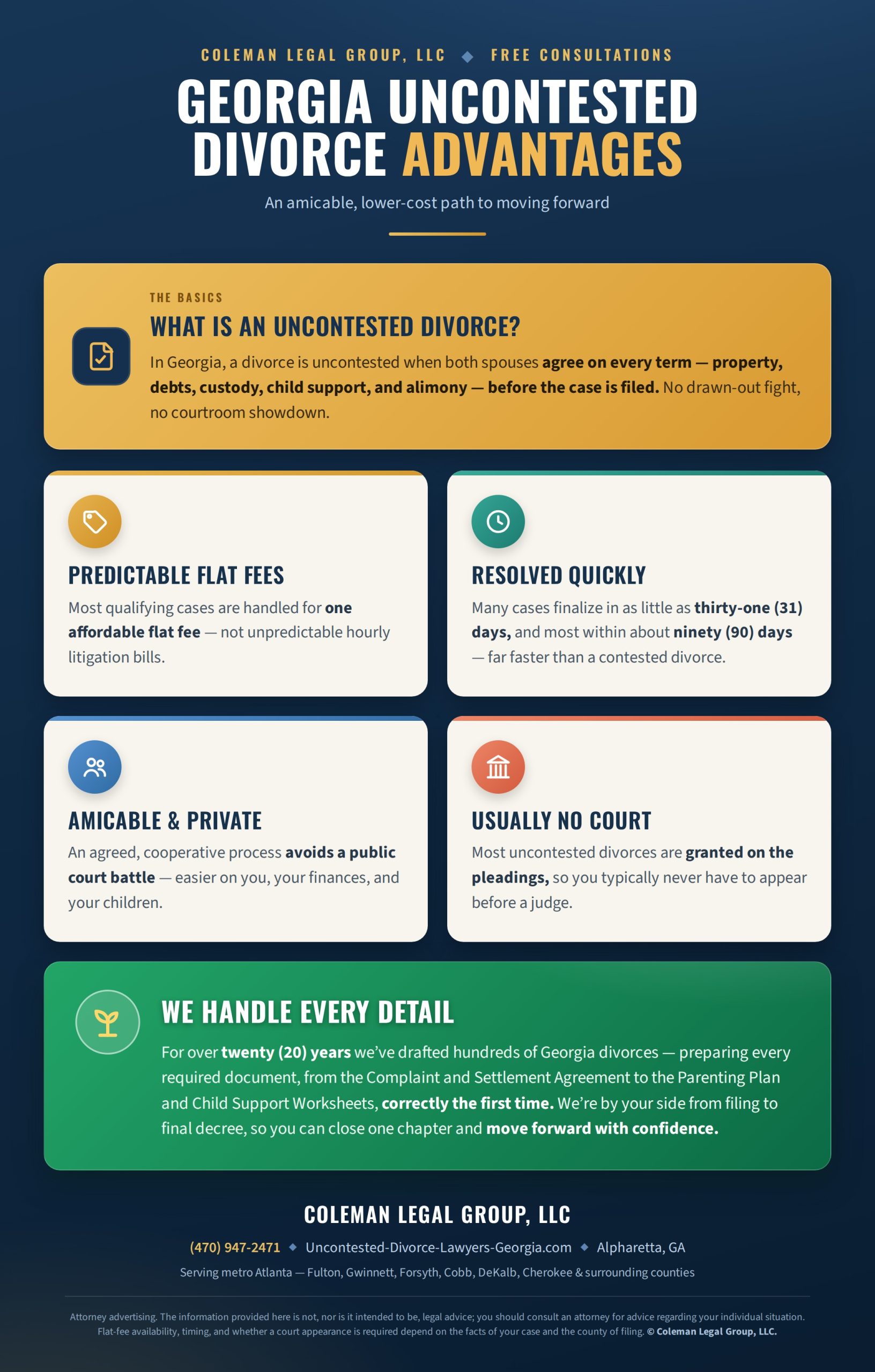
You and your spouse agree on the terms. We prepare every document the court requires and guide it through, so your divorce can be granted in as little as 31 days, usually without a court appearance.
Hourly rates are also an option for cases requiring mediation, negotiation, or that are complex.
Our experienced team of Georgia uncontested divorce lawyers have helped hundreds of clients successfully file simple and complex uncontested divorce cases for over twenty years. Call 470-947-2471 to speak with an experienced Georgia uncontested divorce attorney to get more information. We have extensive experience with cases involving complex child custody, child support, alimony, spousal support, asset, debts and issues regarding estates and business ownership.
Contact > Uncontested Divorce Services > Recent Articles >
Click to Enlarge
At Coleman Legal Group, LLC we understand that an uncontested divorce is very stressful and life altering. However, we will be with you every step of the way. We will not take what should be an amicable divorce and try to turn it into an overblown expensive prolonged contested matter. There are attorneys that try to do this on a routine basis, which is not in the best interest of their client. Trust your instincts and choose an uncontested divorce law firm that puts your interests first.
Coleman Legal Group, LLC offers Flat Fee and Cost Effective Affordable rates for divorce cases that qualify.
The uncontested divorce attorneys at Coleman Legal Group, LLC are also experienced contested divorce litigation lawyers and will be able to deftly, effectively and aggressively represent you should your spouse ultimately refuse to agree to an uncontested divorce. Coleman Legal Group, LLC’s attorneys also practice in all other aspects of family law in Georgia, many of which can also be settled as uncontested matters.
What makes a Georgia divorce uncontested (rather than contested)?
This is a very frequent question that clients have, and the answer is relatively straightforward: In Georgia, an uncontested divorce is a divorce case where the parties are in agreement to all the terms of the divorce before the case is filed. The most common terms that need to be agreed upon are:
- whether both parties actually agree to get divorced, and for the reasons given on the Complaint for Divorce
- how property, assets, and debts will be divided
- who will take the tax deductions for the child(ren)
- how much (if any) alimony and/or spousal support will be paid
- how child custody and visitation with the parties’ minor children will be arranged and scheduled
- how much child support (if any) will be paid, and by which parent
In an uncontested divorce, both parties must be willing to sign all of the necessary pleadings and agreements needed for filing the Georgia uncontested divorce with the court. In addition, the Georgia uncontested divorce will usually be based on a claim made by the plaintiff (the person filing the case) of irreconcilable differences. However, more than one reason can be given for the divorce, but most of the other available legal reasons for a divorce are only usually alleged in contested divorce cases. See Grounds for Divorce – O.C.G.A. § 19-5-3.
The documents we include in our Georgia uncontested divorce filings include:
- Complaint for Divorce (or Petition for Divorce): The document (also known as a pleading) filed with the court officially requesting the court to grant a divorce.
- Verifications: A notarized document attesting to the accuracy of the claims made in the complaint by the person seeking the divorce. A verification is also necessary for the Domestic Relations Financial Affidavit.
- Summons: The document giving notice to your spouse of the divorce filing and the time limit to respond to the divorce. However, responses (called an answer) are not required and are unusual in uncontested divorce cases, and will only delay the issuance of a Final Judgment and Decree of Divorce.
- Acknowledgement of Service: A notarized document signed by the other spouse in a divorce case. It is an admission that he or she has officially received a copy of the request for the divorce (Complaint for Divorce). The other party can either sign the Acknowledgement of Service or be served by a sheriff’s deputy or process server. However, the vast majority of people sign the Acknowledgment of Service as a part of a Georgia uncontested divorce. Service by a sheriff’s deputy or a private process server is not usually needed or part of an uncontested divorce.
- Consent to Try After Thirty-One (31) Days: A document executed by the parties that allows the court to expedite the divorce and grant it in as little as thirty-one (31) days, rather than waiting the normal six (6) months or more. This document does not mean that the parties will have to go to court, but rather it is a request that the court consider and finalize the case after thirty-one (31) days, the legal required minimum number of days.
- Motion for Judgment on Pleadings: A document filed with the court requesting that the court grant the divorce without a court hearing. In most Georgia uncontested divorce cases the motion is granted and the case is finalized without anyone having to go to court and testify.
- Divorce Settlement Agreement: A document signed by both parties and filed with the court outlining the entire divorce agreement of the parties (with the exception of child support and child custody).
- Proposed Order / Decree of Divorce aka Final Judgment and Decree of Divorce: A document submitted to the court to be signed by a judge making a divorce official and completed. This document is signed by the judge and is a court order.
- Domestic Relations Financial Affidavit: A document signed under oath and notarized that is required by the court which summarizes the financial situation of the party signing the affidavit. See Uniform Georgia Superior Court Rule 24.2 and O.C.G.A. § 19-6-15.
- Affidavits and Verifications: Depending on the complexity of the case there will usually be one or more affidavits and verifications filed in a Georgia uncontested divorce case. These documents will need to be notarized.
- Standing Orders: Each court has its own requirements for Standing Order(s). The courts frequently revise and update their Standing Order(s) and the most recent versions must be filed with the case.
- Other Required Documents: This can vary by the county the case is filed in, but will usually include but not limited to: a General Civil and Domestic Relations Case Filing Information Form, General Civil and Domestic Relations Case Disposition Information Form, Report of Divorce, Annulment, or Dissolution of Marriage, and a proposed Final Judgment and Decree of Divorce.
- Request for Hearing and/or Rule Nisi: If needed or helpful to your case, we will include a request for a final hearing. This can usually speed up the process, even if a hearing is not ever scheduled in the case.
In Georgia uncontested divorce cases involving minor children, we also provide the following necessary documents:
- Child Support Worksheet: A document that uses mathematical calculations required by Georgia law to calculate the amount of child support to be paid. When there is more than one child, child support can be stepped down as each child turns eighteen (18) or otherwise ages out of support. We can prepare additional Child Support Worksheets showing the amount for each step and include them with the Child Support Addendum, so the court has the documentation Georgia law requires. Georgia’s Child Support Worksheet also allows for “deviations” which can lower or increase the child support amount depending on the situation and wishes of the parties. See O.C.G.A. § 19-6-15.
- Child Support Addendum: A document that describes in detail all the required aspects of child support in accordance with Georgia law (the amount of child support, duration of the payments, when paid, how paid, etc.) See O.C.G.A. § 19-6-15.
- Parenting Plan: A document that comprehensively outlines all aspects of child custody and visitation, including, but not limited to: a visitation schedule, holidays, legal and physical custody, etc. See O.C.G.A. § 19-9-1.
Other forms may be required based on the county the case is filed in or the judge that the case is assigned to.
These documents may include, but are not limited to:
- Final Disposition Form: A Final Disposition Form mandatory court document filed at the conclusion of a divorce case in Georgia. It officially records the case outcome and provides essential details for court records and statistical purposes. Usually the Court completes the form, but sometimes the Plaintiff in a case must complete and file the Final Disposition Form.
- Report of Divorce (Form 3907): A Report of Divorce is an official document submitted to the Georgia Department of Public Health (DPH) to record the dissolution of a marriage. It serves as a vital statistics record and is separate from the Final Divorce Decree issued by the court. Usually the Court completes this form, but sometimes the Plaintiff in a case must complete and file the Report of Divorce.
- Local County Forms: These forms can vary widely. But some counties have very specific forms that they require to be completed in addition to the forms listed above.
- Motion for Special Set Hearing: A document filed with the court requesting that the case be placed on a specific hearing calendar so a judge can review and finalize the divorce. This is often used when the court requires a brief hearing or when a party wants to move the case forward more quickly.
How long does a Georgia uncontested divorce take to complete?
Most (but not all) uncontested divorces can be finalized within ninety (90) days of the filing of the case. In some counties, a divorce can be finalized within sixty (60) days. While not common, sometimes it can take four (4) months or longer for an uncontested divorce to be finalized. Most uncontested divorces can be granted without a hearing or having to go to court. However, sometimes a video conference call with the court or an in-person final hearing in court will be necessary. Cases involving minor children are more likely to require a court hearing. Fortunately, when a final hearing is required, only the person requesting the divorce is required to attend in person or by video conference. Also, when using the services of an experienced law firm, if there is a final uncontested divorce hearing, it will usually be short and end with the divorce being granted.
In a Georgia uncontested divorce, the husband and wife must be in complete agreement.
In a Georgia uncontested divorce, the husband and wife must be in agreement on how their property will be divided, on how their debts will be divided, and on what the terms for child custody and child support will be before the documents are filed with the court. Also, the husband and wife must be in agreement regarding how much (if any) alimony will be paid and for how long. If the husband and wife are not in complete agreement on all the required legal terms of a divorce, then they do not have an uncontested divorce case. To resolve this situation, the parties can continue negotiation, attend mediation, and work toward reaching a complete divorce agreement. If all else fails, one of the parties has the option of filing a contested divorce case. When the parties are in total agreement regarding the terms of the divorce, the settlement agreement and related documents will need to be drafted in a legal format that the court will approve.
If your uncontested divorce case is important to you, hire an experienced professional Georgia uncontested divorce attorney.
The drafting of the documents required for an uncontested divorce can be quite difficult for a non-lawyer. Even inexperienced lawyers will frequently make minor (if not serious) mistakes in drafting uncontested divorce documents. This is especially true when minor children are involved. The Georgia uncontested divorce attorneys at Coleman Legal Group, LLC have negotiated and drafted hundreds of simple and complex divorce agreements that the courts have approved and most without a court hearing ever being necessary. We have also helped several clients that have either reached an impasse with the court when trying to complete an uncontested divorce without the aid of an attorney, or wish to now settle what started out as a contested divorce.
Complex Asset Issues in Uncontested Divorce Cases
When an uncontested divorce involves complex financial issues or significant assets, it is important to properly evaluate and structure the division to avoid unintended tax consequences and long-term financial problems. Even in an uncontested divorce in Georgia, the way assets are divided can have a lasting impact on both parties’ financial futures.
Our attorneys help clients address complex asset division in divorce, including real estate, retirement accounts (such as 401(k)s and pensions requiring QDROs), investment portfolios, business interests, and high-value personal property. We focus on creating clear, practical agreements that account for valuation, timing of transfers, refinancing issues, and potential tax consequences such as capital gains and early withdrawal penalties.
We also help clients understand how property division in a Georgia divorce may affect ownership rights, liability exposure, and long-term financial planning. When appropriate, we work with tax professionals, accountants, financial planners, and other experts to ensure that all aspects of the asset division are fully considered.
Our goal is to help you formulate, negotiate, and finalize a divorce agreement that is not only fair on paper, but also practical, enforceable, and designed to protect your financial interests, both now and in the future.
Complex Debt Issues in Uncontested Divorce Cases
When an uncontested divorce involves complex debt issues, such as credit card balances, personal loans, business debts, personal guarantees, SBA loans, tax liabilities, or jointly held obligations, it is important to understand how debt is handled under Georgia law. It is important to know that even if a divorce agreement assigns a debt to one spouse, the original creditor may still pursue both parties if the account remains in both names.
Our attorneys help clients navigate these risks by carefully structuring divorce settlement agreements to clearly allocate responsibility for each debt. This often includes indemnification provisions, as well as practical steps such as refinancing, paying off accounts, or closing joint obligations when appropriate. The goal is not just to divide debt on paper, but to reduce the likelihood of future financial exposure.
We also assist in identifying less obvious risks, including business-related debts, personal guarantees, and tax liabilities, which can create ongoing liability even after the divorce is finalized. When necessary, we work with accountants and financial professionals to evaluate the short- and long-term impact of debt division, including credit consequences and enforcement considerations.
If you are going through an uncontested divorce in Georgia and have concerns about debt, our firm can help you create a clear, enforceable, and practical plan that protects your financial future, both now and after the divorce is complete.
Simple Uncontested Divorce Cases
We also assist with simple divorces by helping guide our clients through the legal forms and process, which will save you much time and frustration. We do this by helping move your uncontested divorce case through the court as quickly and efficiently as possible. In many of our cases, our clients do not even have to go to court to get their final decree of divorce. We help our clients avoid court when possible by preparing and executing the necessary documents to avoid a final divorce hearing in court. In cases that qualify, we can offer Flat Fee rates for simple uncontested divorce cases where the scope of the case is limited.
Complex Issues in Uncontested Divorces
We are experienced in handling more complex uncontested divorce cases and routinely guide our clients through the process of turning detailed financial and custody arrangements into clear, enforceable agreements that courts will approve.
Complex uncontested divorce cases often involve issues such as shared or split custody arrangements, deviations from standard child support guidelines, multiple financial accounts or real estate holdings, significant asset or debt division, or unique parenting plans. These matters require careful planning and precise drafting to ensure that the agreement is both fair and legally sound.
While a final court hearing is more common in complex cases, many of our clients are still able to finalize their divorce without ever having to appear in court, depending on the county and specific circumstances.
Once we have enough information about your situation, complex uncontested divorce cases can typically be quoted on a flat-fee basis. In certain situations, hourly billing may be more appropriate depending on the scope and complexity of the issues involved.
Uncontested Divorce Mediation and Negotiation
If your case is complicated or you are having difficulty reaching an uncontested divorce agreement, we strongly advise our clients to consider mediation. When you are a client of Coleman Legal Group, LLC, we will be by your side every step of the way during mediation. We help choose the mediator that we feel will be fair, neutral, and effective in helping the parties reach an agreement. We can also usually schedule the formal mediation session in our office or in another neutral location where you will feel comfortable. It has been our experience that when both parties truly want to reach an agreement, mediation often works.
However, in some cases, both spouses may not be ready for either party to hire an attorney, or they may simply need a neutral mediator to help them discuss the issues and work toward an agreement. If you are looking for neutral divorce mediation rather than legal representation for one spouse, you may visit Agreeable Mediation, LLC at AgreeableMediation.com. Mediation is not a substitute for independent legal advice, and a mediator does not represent either party. However, for many couples, working with a neutral mediator can be a practical first step toward reaching an uncontested divorce agreement.
Uncontested Divorce FAQs
How long does an uncontested divorce take in Georgia?
Most uncontested divorces are finalized within about 90 days of filing, and some counties can finalize them within 60 days. The earliest a Georgia court can grant a divorce is 31 days after filing.
Will I have to go to court?
Usually not. Most uncontested divorces are granted without a hearing. When a final hearing is required, often in cases with minor children, only the spouse who filed usually needs to attend, in person or by video.
What do we need to agree on?
Whether to divorce, how to divide property and debts, alimony (if any), child custody and visitation, child support, and who takes the tax deductions for the children.
What if we do not agree on everything yet?
You can keep negotiating or try mediation. We can represent you through mediation, and couples who want a neutral mediator instead can visit Agreeable Mediation, LLC at AgreeableMediation.com.
How much does it cost?
We offer flat fees for most uncontested divorce cases. Complex cases can often be quoted on a flat-fee basis once we understand the details, and hourly billing is available when that fits better. Call 470-947-2471 for a free consultation.
Give us a call at 470-947-2471 to arrange a confidential consultation with one of our Georgia uncontested divorce attorneys. Evening and weekend appointments are available.
Our Georgia uncontested divorce lawyers handle cases for clients residing in the following counties: Fulton, Gwinnett, Forsyth, Cobb, DeKalb, Henry, Cherokee, Douglas, Carroll, Coweta, Paulding, Bartow, Hall, Barrow, Walton, Newton, Rockdale, Spalding, Fayette, and Clayton.
Coleman Legal Group, LLC’s Georgia lawyers practice in the areas of Divorce, Family Law, Bankruptcy, Real Estate, Business, Estates, Wills, Trusts, Immigration, and Sports / Entertainment Law.
Our main office is located in Alpharetta Georgia at: 11539 Park Woods Circle, Suite 304, Alpharetta, GA 30005.
We also have offices conveniently located at:
| Alpharetta Georgia Park Woods Commons 11539 Park Woods Circle Suite 304 Alpharetta, GA 30005 Phone: 470-947-2471 | Map |
Atlanta Georgia |
| Dunwoody, Sandy Springs GA 400, Atlanta Georgia 1200 Abernathy Rd Building 600 Atlanta, GA 30328 Phone: 470-947-2471 | Map |
Cumming Georgia |
| Johns Creek, Duluth GA 11555 Medlock Bridge Road Suite 100 Johns Creek, GA 30097 Phone: 470-947-2471 | Map |
Duluth Georgia |
| Kennesaw Georgia TownPark Center 125 TownPark Drive Suite 300 Kennesaw, GA 30144 Phone: 470-947-2471 | Map |
Lawrenceville |
Copyright © 2026 | Coleman Legal Group, LLC | All Rights Reserved. Coleman Legal Group, LLC • 11539 Park Woods Circle, Suite 304 • Alpharetta, Georgia 30005 • 470-947-2471 DISCLAIMER: The information you obtain at this site is not, nor is it intended to be, legal advice. You should consult an attorney for individual advice regarding your own situation.
Updated: 2026-10-11